
Socks to Wear With Dress Shoes: 5 Easy Style Tips
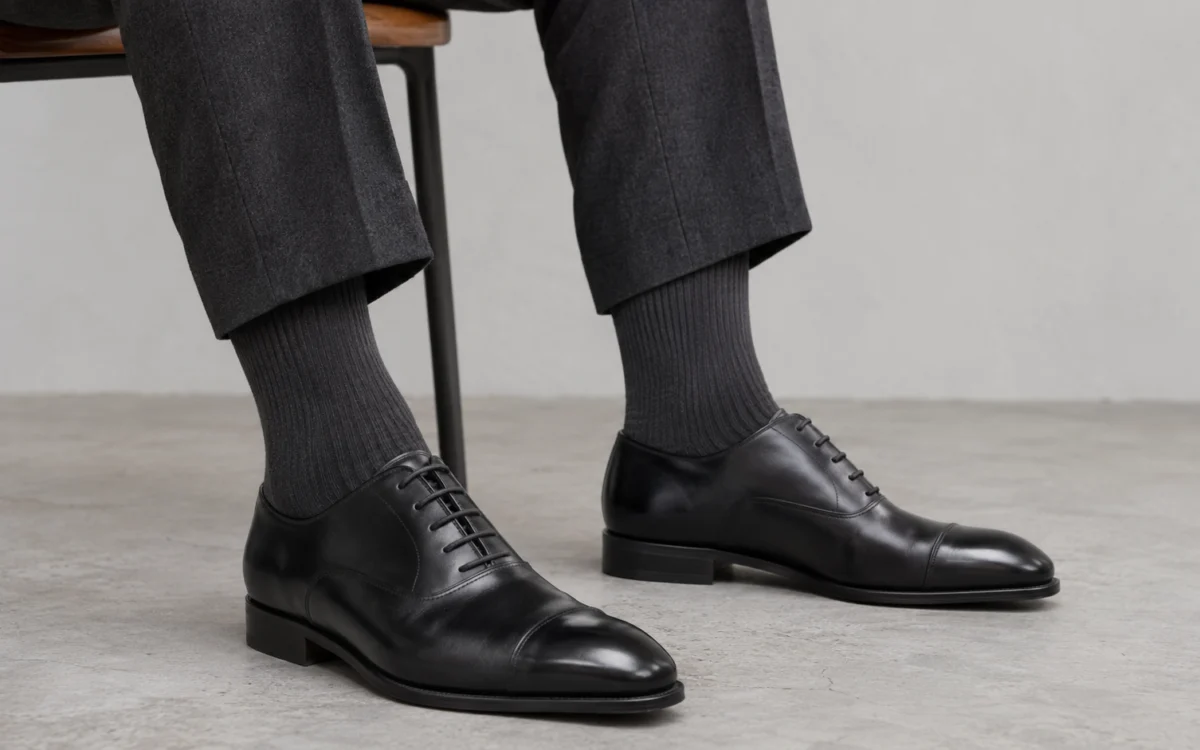
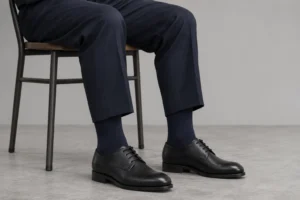
Choose fine-knit dress socks that fit comfortably inside your shoes, stay in place, and provide the coverage you want when sitting. For a restrained suit outfit, start with a solid color close to your trousers. Black socks with black trousers and navy socks with navy trousers are simple combinations to try.
The best socks to wear with dress shoes depend on the shoes, pants, occasion, and your own comfort. A thick sports sock can change how a close-fitting Oxford feels, while a low-cut liner may be suitable for casual loafers but leave more ankle visible than you want with a suit.
Use these five checks to choose a pair without treating every outfit as a strict matching exercise.
Socks to Wear With Dress Shoes at a Glance
| Outfit or shoe | Suggested starting point | What to check |
| Black suit and black lace-ups | Fine-knit black dress socks | Coverage when seated and fit inside the shoe |
| Navy trousers and black shoes | Navy dress socks | Similar depth of color to the trousers |
| Charcoal trousers and brown shoes | Charcoal dress socks | Comfortable thickness and a quiet overall combination |
| Loafers with tailored trousers | Lightweight dress socks | Sock visibility and the event’s dress code |
| Casual loafers with chinos | Dress socks or a suitable no-show liner | Whether the liner stays in place and remains hidden |
| Dress boots in cool weather | Socks tall enough to cover the boot contact area | Available room inside the boot |
These are outfit suggestions, not requirements. A deliberate contrast can work too, particularly in a relaxed setting.
1. Start With Sock Thickness and Shoe Fit
Try the socks with the actual shoes before deciding whether the pairing works. A shoe that fits comfortably with a thin sock may feel crowded with a thick cushioned sports sock.
For close-fitting dress shoes, start with a smooth, relatively fine knit. Darn Tough’s dress-shoe sock guide also emphasizes a lightweight option for closely fitted shoes. That does not mean every dress sock must be extremely thin; the right amount of fabric depends on the room inside your pair.
Check the heel and toe position before putting the shoe on. The sock’s heel section should sit around your heel, and the toes should not be pulled tightly together by an undersized sock.
Once the shoes are fastened, walk and sit down. Look for fabric folded beneath the foot, a toe seam you keep noticing, or pressure that was absent with a different pair. Change the sock or shoe fit instead of assuming discomfort is necessary for a smart outfit.
2. Choose a Length That Works When Seated
Standing in front of a mirror shows only part of the outfit. Trousers rise when you sit, so a sock that looks tall enough while standing may leave an unexpected gap of bare leg above it.
Mid-calf and over-the-calf dress socks are useful options. The names refer to where the sock reaches on the leg; an over-the-calf style extends farther and usually sits below the knee. Boardroom Socks explains these length categories in its buying guide.
For a conservative suit outfit, try a longer pair if you prefer continuous coverage between the trouser hem and shoe. If a mid-calf pair provides that coverage and stays comfortable, there is no need to replace it simply because another style is longer.
A short sports sock or ankle sock creates a different look. It may be suitable for a casual outfit, but it is not the same visual choice as a tall dress sock under tailored trousers.
3. Coordinate With Your Trousers First
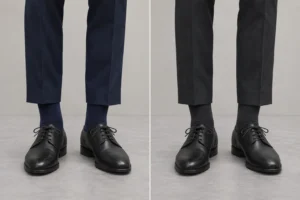
Matching the trousers is an easy starting point because the sock visually continues the trouser color toward the shoe. The match can be tonal rather than identical.
Try these combinations:
- Black trousers and black shoes: Black dress socks create a restrained combination.
- Navy trousers and black shoes: Navy socks keep the trousers and socks visually connected even though the shoes differ.
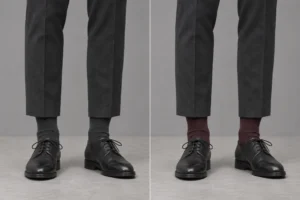
- Charcoal trousers and brown shoes: Charcoal socks provide a quiet link to the trousers.
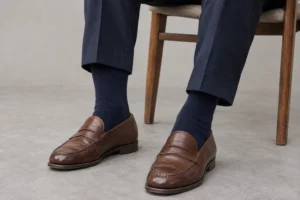
- Light chinos and brown loafers: Try a muted sock that works with the pants, or consider no-show liners if the outfit is casual enough.
You do not have to match every sock to the shoe. A black shoe worn with navy trousers does not automatically require a black sock.
Once you like the basic combination, a subtle stripe, small pattern, or muted contrasting color can add interest. For an interview or event with conservative expectations, a solid pair is a simpler starting point than a bright novelty design.
If you are building a darker suit outfit, our guide to shoes to wear with a black suit covers the footwear choice before you decide on socks.
4. Read the Material Label Rather Than Buying by Appearance
Dress socks are available in cotton, wool, and blends containing different fibers. Material names alone do not tell you how thick, soft, stretchy, or warm a particular pair will feel. Knit construction and the proportions in a blend matter too.
A fine cotton or cotton-blend sock can be a practical starting point for everyday outfits. Fine wool and wool-blend dress socks are another option if you like their feel. Compare actual pairs at a similar thickness rather than assuming all wool socks are bulky or all cotton socks are lightweight.
Check the manufacturer’s sizing and care guidance. Shrinkage, stretching, and drying instructions vary between products, so do not apply one washing routine to every pair.
For a long event, try the intended socks and shoes together beforehand. A short walk is more informative than choosing solely from a photograph or a fiber label.
5. Adjust for Loafers Boots and the Occasion
Oxfords and Derbies: Start with a fine-knit dress sock in the length and color that suit your trousers. Choose the fit first; a familiar shoe name does not guarantee that every model has the same internal space.
Loafers: Visible dress socks work with many tailored outfits. For a relaxed warm-weather look, a no-show liner can give the appearance of bare ankles while leaving fabric between the foot and shoe. Choose a liner cut for the loafer’s opening, then check that it does not slip or peek out unexpectedly.
Dress boots: Look for enough sock height to cover the area where the boot touches your leg. A thicker pair may be comfortable in one boot and too bulky in another. Check before assuming that cold weather requires the thickest sock available.
Formal events: Follow the invitation’s dress code and the whole outfit. Do not assume that a casual loafer-and-no-show combination is appropriate simply because the shoes are leather.
Mistakes to Check Before Leaving
You do not need a large sock collection to avoid the common problems. Check these details with the complete outfit on:
- Bunched fabric: Smooth the sock before fastening the shoe. Repeated bunching may mean the size or fit is unsuitable.
- A sliding cuff: Try another size or design if you keep pulling it up.
- Unexpected ankle gaps: Sit down before deciding that the sock is long enough.
- Extra bulk: Thick sports socks can crowd a shoe that fits well with dress socks.
- Distracting contrast: Check whether a bright sock works with the event rather than choosing it in isolation.
- Visible wear: Inspect heels, toes, and cuffs for holes, thinning, and stretched sections.
Frequently Asked Questions
Should dress socks match your pants or shoes?
Matching the pants is a useful starting point, particularly with tailored trousers. It is not a universal requirement. Coordinated colors and deliberate contrasts can work when the setting allows them.
Can you wear white socks with dress shoes?
Yes, as an intentional styling choice in a suitable casual outfit. White socks produce a visible contrast with dark shoes and trousers, so they are not the simplest default for a conservative suit outfit.
Can you wear dress shoes without socks?
Some relaxed outfits use a bare-ankle look, especially with loafers. A suitable no-show liner is an option if you want that appearance. It is not necessary to adopt the look, and dress-code expectations may call for visible dress socks.
Are thin socks always better for dress shoes?
No. The useful question is whether the sock and shoe fit comfortably together. Start with a finer knit for close-fitting shoes, then adjust to the space available and the amount of cushioning you prefer.
How many pairs of dress socks do you need?
Start with enough clean pairs for the days you wear dress shoes between washes. Choose a few colors that work with your actual trousers before adding patterns or occasional-use shades.
When choosing socks to wear with dress shoes, begin with fit, seated coverage, and a color that works with your trousers. Those three checks will help you choose more reliably than following a rule based only on shoe color.