
Intent vs impact is the gap between what you meant to do and what the other person actually felt. The best of intentions can do little good if the result is harm. The opposite happens too: you can mean nothing by a remark and still leave a mark. These things happen more often than we think, and we usually only notice when we’re on the other side of the coin.
Imagine a manager telling a new employee, “Oh, you did that fast.” She meant it as praise. He heard a hint that the work must have been sloppy. Nobody was lying and nobody was being cruel. The words just landed somewhere other than where they were thrown.
This article explains what intent vs impact means, why the gap shows up even when two people like each other, and how knowing about it can help you on either side of the conversation.
Understanding what intent vs impact means
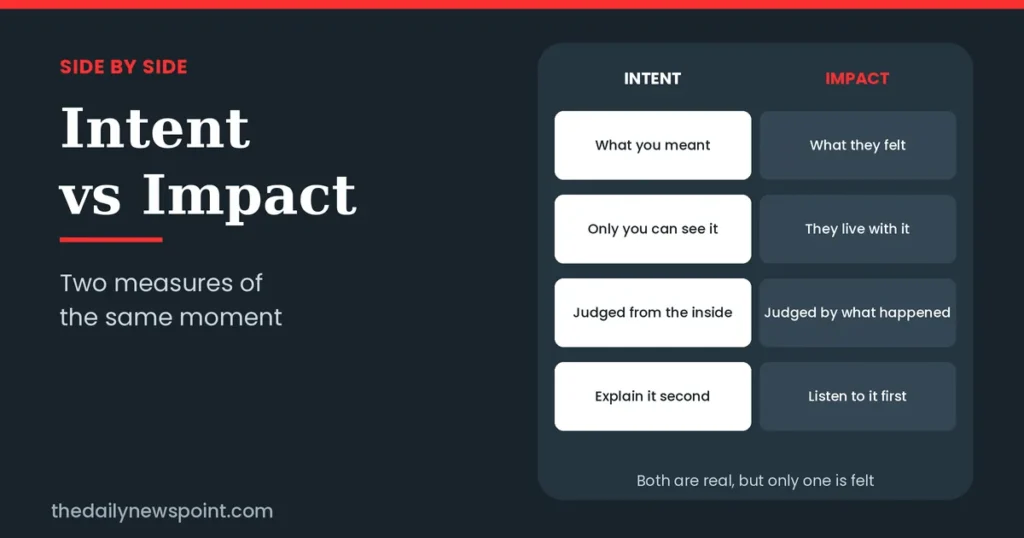
Your goal, meaning what you were trying to do, say or achieve, is the intent. The impact is what changed for the other person: what they went through and how it affected them. Only you know your intent. The other person only sees the impact.
That one-sided view is the whole problem. When you replay a moment in your head, you play it with the music of your own good reasons. They never heard that soundtrack. They got a tone of voice, a handful of words and a certain timing, and they filled in the rest.
None of this makes intent worthless. It matters when we judge someone’s character, and it matters in how we talk about the mistake afterwards. But it can’t reverse what has already happened. If someone steps on your foot by accident, they’re still standing on your foot.
Why the gap between intent and impact exists
Scientists have been studying this for years. Psychologists Justin Kruger and Nicholas Epley ran a series of email experiments and found that people overestimate how well they get their intended tone across, whether it’s funny, serious or sarcastic. Their explanation is egocentrism: it’s hard to get out of your own head. The American Psychological Association has a plain-language summary in its Monitor on Psychology.
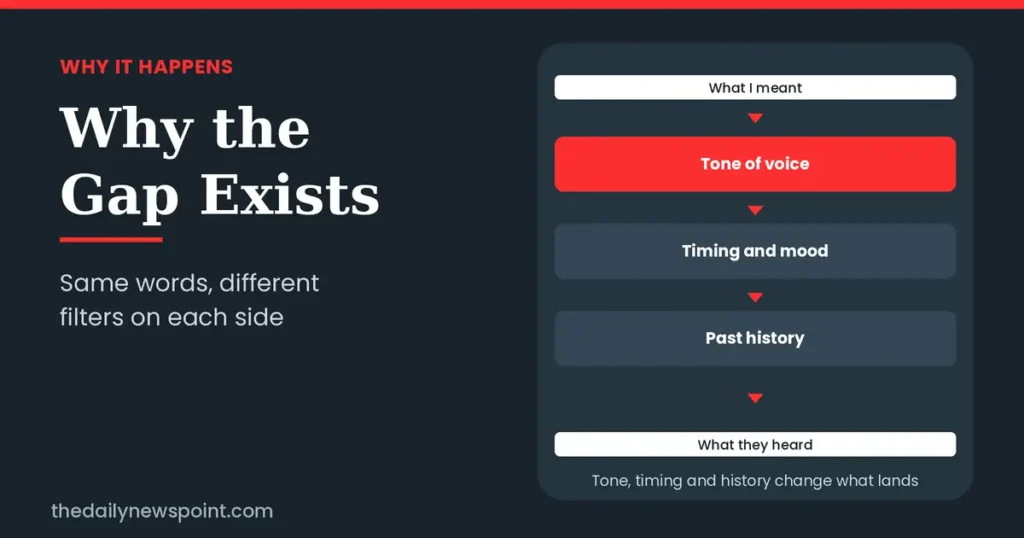
Email is the easy example, but the same thing happens out loud. A few things bend a message on its way to the other person:
- Tone. You can sound flat and cold even when you’re just tired.
- Timing. A joke that works on a good day lands as a dig on a bad one.
- History. After a lot of criticism, even a neutral message feels like one too many.
- Power. A comment from a boss weighs more than the same comment from a coworker.
No one is a villain in this. Most intent vs impact collisions happen between two good people who each see only their own side of the issue.
Intent vs impact at work, at home and online
At work, feedback is the usual pitfall. “This needs another pass” can be an ordinary editing comment or a bummer, depending on the week the person is having. Managers think their intent is obvious because they know their own minds, but their staff has no access to it.
At home, it gets personal. “You always forget” might be a clumsy way of saying you’re overwhelmed. Your partner hears that they’re failing. The argument that follows is about the sentence, and the real issue never gets said.
Online, there’s no raised eyebrow to soften anything. A reply of “fine.” could be a genuine fine, or it could mean everything else. In a group chat, a throwaway line can easily turn into a week of silence.
7 ways to handle intent vs impact
Whether you caused the hurt or you’re the one feeling it, these seven habits will help you handle intent vs impact better.
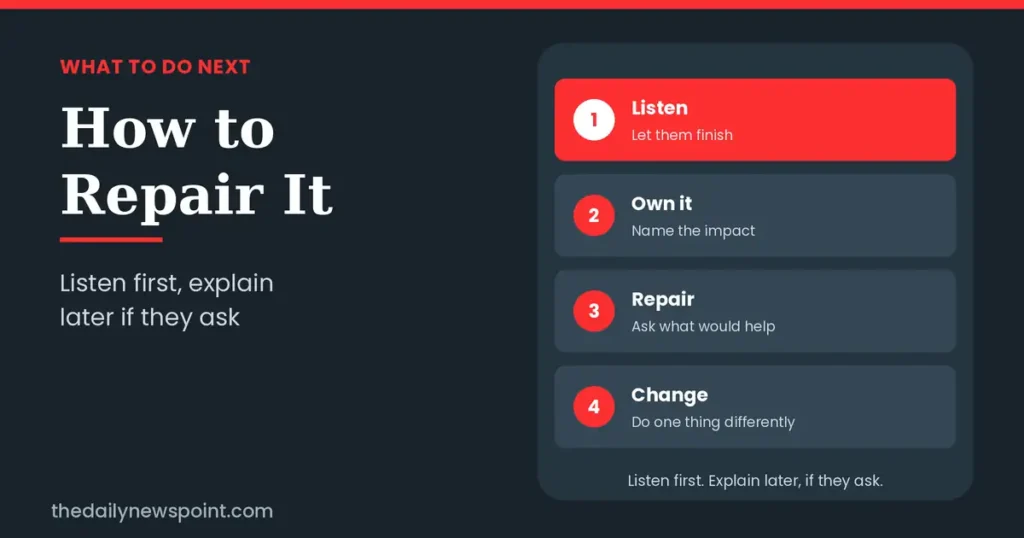
1. Hold off on explaining
The first impulse is defence. Hold it for a few seconds. Even if you don’t mean it that way, defending yourself right away tells the other person that your side of the story matters more than their experience. A slow breath costs nothing.
2. Let them finish and hear the impact first
Don’t correct the details yet. You’re trying to understand what landed, not win an argument about the words. If something isn’t clear, ask.
3. Go easy on “but I meant”
“I didn’t mean it like that” can be true and still unhelpful, especially as an opener. If you do share your intent, wait until you’ve acknowledged the impact, and keep it to one sentence.
4. Say sorry for the effect
Compare “I’m sorry you were offended” with “I’m sorry that made you feel dismissed.” The second one states what actually happened. The first quietly puts the problem on their shoulders.
5. Ask what would help
Don’t guess. Some people want a quick acknowledgement. Others want the decision changed. Others want to be left alone for an hour. “What would help right now?” saves a lot of wrong guesses.
6. Make a change, or the apology is in vain
Choose one small, specific thing to do differently, for example giving hard feedback on a call instead of in a group chat, and then do it.
7. Read your text or email before sending
If it still works without tone, it’s probably safe. If it only works with a friendly voice in your head, rewrite it. Stating clearly what you want, plus a warm sentence, is often enough. Since the research suggests people rate their own tone higher than it really is, those ten seconds are worth it.
What to do when you’re the one who was hurt
Being on the receiving end of intent vs impact takes its own skill. Avoid the accusation (“You are being so rude!”) and describe what happened and what it meant for you: “The meeting notes didn’t include my name, and I felt left out.” That keeps the discussion on an event, which is easier to talk about than someone’s character.
It also helps to give the other person a chance to tell their side. That doesn’t mean you have to treat it as an excuse. Listening for their intent tells you whether this was a single slip or an ongoing pattern, and if it’s a pattern, the intent matters less and the change matters more.
Better wording may be all the conversation needs. If the harm is serious or it keeps happening, though, a mediator, an HR team or a counsellor may be needed.
Common mistakes with intent vs impact
A few errors show up all too often.
- Treating good intent as a free pass. It describes what you were trying to do. It doesn’t undo what happened.
- Assuming a bad reaction means bad intent. Being hurt by an honest mistake is different from being hurt on purpose, and the repair doesn’t look the same either.
- Over-apologising. If the other person ends up comforting you after your apology, the focus has drifted back to you.
- Raising it mid-argument. A calm talk the next day usually goes better than a full-volume fight.
Quick answers about intent vs impact
Does intent matter at all? Yes. It shapes how we see people, and it influences how a repair should go. It just doesn’t cancel out what happened.
What if I think they’re overreacting? You can argue about the size of the reaction and still take it seriously. Ask which part was hardest for them. There may be history you haven’t seen.
The short version
In intent vs impact, intent is yours and impact is theirs. When the two don’t match, the easy move is almost never to argue over which one counts more. Listen, own the effect, ask what would help and change one thing. Do that and most conflicts about intent vs impact get smaller instead of bigger.
This article offers general communication advice and isn’t a substitute for professional counselling.
Read More At: TheDailyNewsPoint
Contact Us At: TheDailyNewsPoint